Articles
Vacuum Conveying: Cross‑Industry Advantages and How Gough Adds Value
14th January 2026
•
4 min read
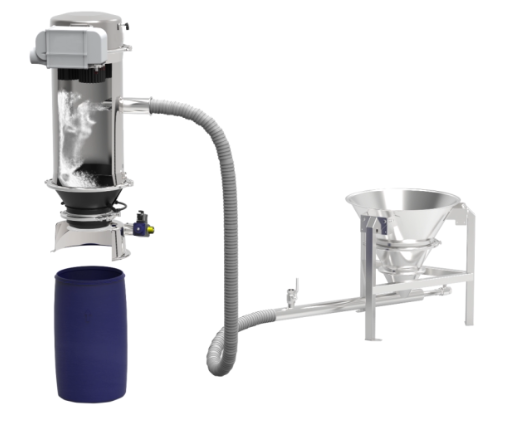
Modern manufacturers in food, plastics, chemicals, pharmaceuticals and additive manufacturing all face the same challenge: how to move powders, granules and small components safely, cleanly and efficiently.
Vacuum conveyors create a safer workplace compared to other powder transport methods by enclosing the material throughout transfer. This ergonomic approach helps prevent cross-contamination, protects product integrity, eliminates manual handling, and enhances worker safety simultaneously.
Vacuum conveying systems, such as those from Piab and Jenco, have become a preferred solution for hygienic, automated product transfer, especially when integrated by a specialist like Gough Engineering.
They have shifted from a niche transfer method to a strategic technology that underpins productivity, quality and compliance.
Gough Engineering supports customers across food, plastics and polymers, chemicals, manufacturing and recycling.
Below are the key cross‑industry benefits driving a growing adoption within these sectors.
1. Hygienic, contamination‑controlled transfer
Vacuum conveying systems excel in applications where cleanliness is critical.
For sterile environments such as pharmaceuticals or high-purity foods, these systems help meet rigorous GMP, FDA and EHEDG requirements.
- Closed-loop design: As a closed system, it helps to prevent dust emissions, airborne contamination and operator exposure while product is being transferred.
- Sanitary materials: When designed with sanitary materials and smooth internal finishes, it supports fast cleaning, minimal product residue and compliance with demanding food and pharma hygiene standards.
- HEPA and high-efficiency filtration options protect both product and plant environment.
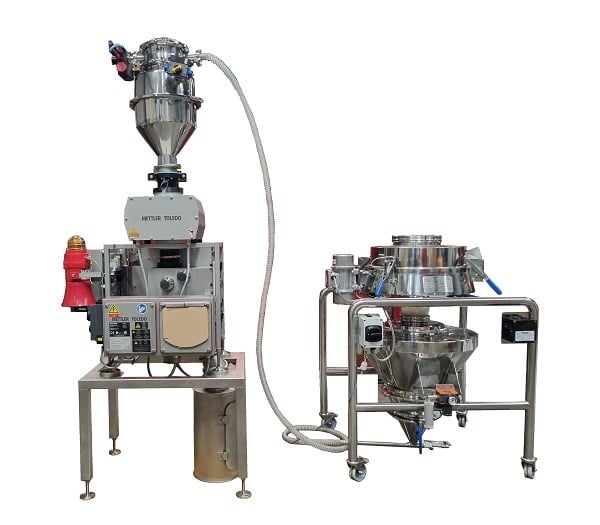
Gough Engineering – Check Screen Sieve, hopper and Piab Vacuum System leading into an auto-reject metal detection system before packing.
At Gough Engineering, vacuum conveyors are often combined with check screening and metal detection to create fully enclosed, hygienic lines from bulk intake through to packing.
2. Improved operator safety and ergonomics
Replacing manual bag lifting, scooping and pouring with automated vacuum transfer reduces heavy handling, repetitive strain and dust inhalation risks on the shop floor.
This supports health and safety compliance and can improve retention in labour‑intensive areas such as batching, mixing and packing.
Gough can further reduce risk by integrating dust‑tight product inlets, guarded access platforms and interlocked equipment around each conveying point.
3. Consistent, automated material flow
Whether conveying fine powders, granules, coffee beans, plastic pellets, metal powders, or fragile food ingredients, vacuum conveyors provide:
- Reliable, consistent throughput, even with poor-flow materials
- Automated loading and replenishment, reducing downtime
- Scalability, from small batch operations to full-scale continuous production
Gough Engineering integrates vacuum conveyors from Piab, Jenco and other leading suppliers into complete handling schemes, designing systems that match conveying distance, throughput and product characteristics to the correct conveyor size and configuration.
Piab’s COAX® vacuum technology and Jenco’s modular designs, for example, deliver stable vacuum performance even under varying material loads.
4. Cleaner, dust‑reduced production areas
Fugitive dust can damage equipment, contaminate product and raise housekeeping and explosive‑atmosphere concerns.
A well‑specified vacuum conveying system reduces open transfers and spillage points, keeping floors and adjacent equipment cleaner and improving air quality. This helps minimise unplanned clean-downs and contributes to better overall plant uptime, translating directly into operational savings.
Gough’s experience in designing hoppers, feeders and interfaces around vacuum inlets and outlets further reduces dust escape points in the full scheme.
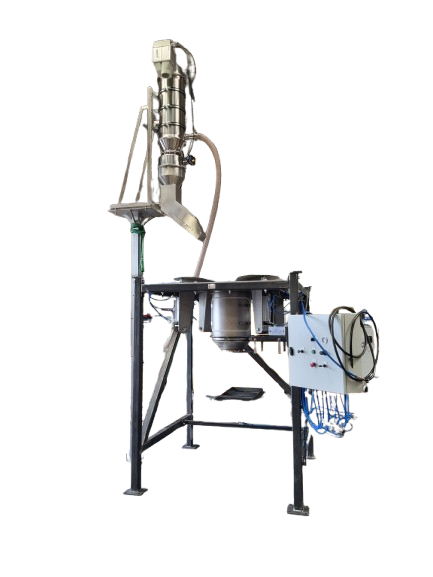
Gough Engineering – Test rig of vacuum conveying unit
5. Maximised efficiency and lower labour costs
Automating product transfer reduces the time operators spend moving materials between process stages and lowers the risk of delays caused by manual loading. This can cut labour costs, reduce product waste caused by spillage and support faster changeovers between products.
Gough Engineering can integrate vacuum conveyors seamlessly with upstream sieves, screens and separators and downstream product handling equipment such as mixers, blenders, 3D printers, packaging lines, and reactors to create a joined‑up, efficient material handling system, delivering a more streamlined operation and a faster return on investment.
6. Gentle handling to protect product quality
Some products, such as fragile food ingredients, speciality chemicals and tablets, are sensitive to breakage, segregation or abrasion during transfer.
To preserve particle integrity in fragile or sensitive products, vacuum conveying moves materials at controlled speeds and eliminates the mechanical agitation/degradation found in screw or some belt systems.
This is particularly valuable where product appearance, bulk density or blend homogeneity are critical, such as in industries like food and nutraceuticals.
7. Flexible, modular integration
Vacuum conveyors are compact and can be configured for short to medium transfer distances, making them suitable for both new installations and retrofit projects. Options such as mobile frames, multiple inlet points and different discharge arrangements allow one system to feed several pieces of equipment.
Gough Engineering designs and manufactures supporting structures, hoppers, feeders and transfer points so that vacuum conveyors can be integrated with existing lines or combined with bucket elevators, vibratory feeders and other conveying technologies. From feeding injection moulding machines to supplying metal powders for additive manufacturing, this flexibility supports a wide range of applications.
8. Supporting sustainability and energy performance
Modern vacuum conveying solutions can reduce product loss, dust emissions and the energy spent on re‑cleaning or reprocessing off‑spec material.
Ejector‑driven and mechanical pump options allow systems to be matched to site utilities and energy objectives.
Where systems use compressed air, modern ejector designs can reduce air consumption compared with older setups.
By reviewing different transfer options, Gough Engineering helps customers choose where vacuum conveying is the best fit, supporting businesses to meet their sustainability goals and lower operational costs.
Important Information to think about:
If you’re thinking of talking with us, some crucial information to have at hand is:
- Bulk density of product material
- Throughput required in kg per hour
- Is the product fragile
- Is there a moisture content within the product
- How high to you need to elevate the product
- If there is a specific route around equipment for conveying, how long is each section of straight piping and how many bends are there?
- Is a small hopper possible from the feed in point?
- Is the product material food-related, requiring Stainless Steel 304 or 316?
Contact Gough Engineering to enhance your vacuum conveying projects
As a UK‑based designer and manufacturer of complete material handling schemes, Gough Engineering provides more than just the conveyor.
Our capabilities include in‑house fabrication, assembly, testing, installation and commissioning, plus ongoing after‑sales support.
Gough’s key strengths include:
- Full system design, including hoppers, feed arrangements, discharge chutes, supports and access.
- Integration of vacuum conveying with screening and separation equipment, bucket elevators, vibratory feeders and metal detection.
- Product trials to understand material behaviour before finalising the solution.
- Retrofit solutions to upgrade existing lines with minimal disruption.
To explore how vacuum conveying could be integrated into a new or existing production line, contact Gough Engineering’s technical sales team on +44 (0)1782 567770 or email contact@goughengineering.com.
Further information on Piab vacuum conveying, product handling equipment and conveying schemes is available on the Gough website.
More Links at Gough Engineering
Sieves, Screens and Separators
https://www.goughengineering.com/en/sieves-screens-separators
Transfer Equipment
https://www.goughengineering.com/en/product-handling-equipment
Piab Conveying
https://www.goughengineering.com/en/product-handling-equipment/piab
Schemes
https://www.goughengineering.com/en/product-handling-equipment/product-conveying-schemes