Introduction
Big Bag Dischargers — also known as FIBC dischargers, bulk bag unloaders, or bulk bag discharge stations — are a cornerstone of safe and efficient bulk material handling across UK industry.
Whether you are processing powders, granules, flakes, or other dry bulk goods in food production, chemical manufacturing, construction, pharmaceuticals, agriculture, or plastics, a well-specified discharge system eliminates manual handling, reduces the risk of contamination, and keeps production lines running.
This guide covers everything a UK engineer or procurement manager needs to know: what big bag dischargers are, how the main configurations differ, what to consider when specifying a system, how they are applied across key sectors, and what makes Gough Engineering's GBB range a trusted choice for UK manufacturers — including global brands such as Lavazza, Ineos, British Sugar, Valio, Games Workshop and more.
What is a Big Bag Discharger?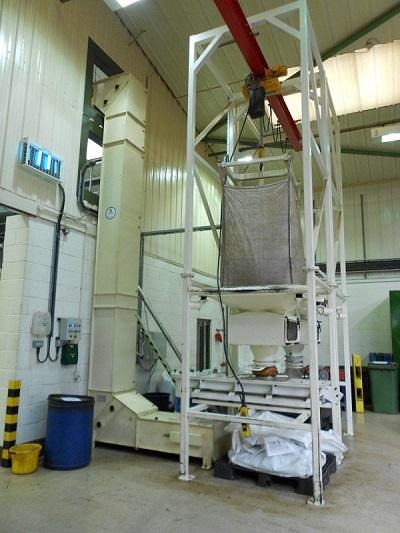
A Big Bag Discharger is a mechanical system designed to safely and efficiently empty Flexible Intermediate Bulk Containers (FIBCs) — typically weighing between 500 kg and 1,500 kg — without manual handling of the material.
The system suspends or seats the bag, provides controlled access to the outlet, and discharges material into downstream process equipment in a contained, dust-free manner.
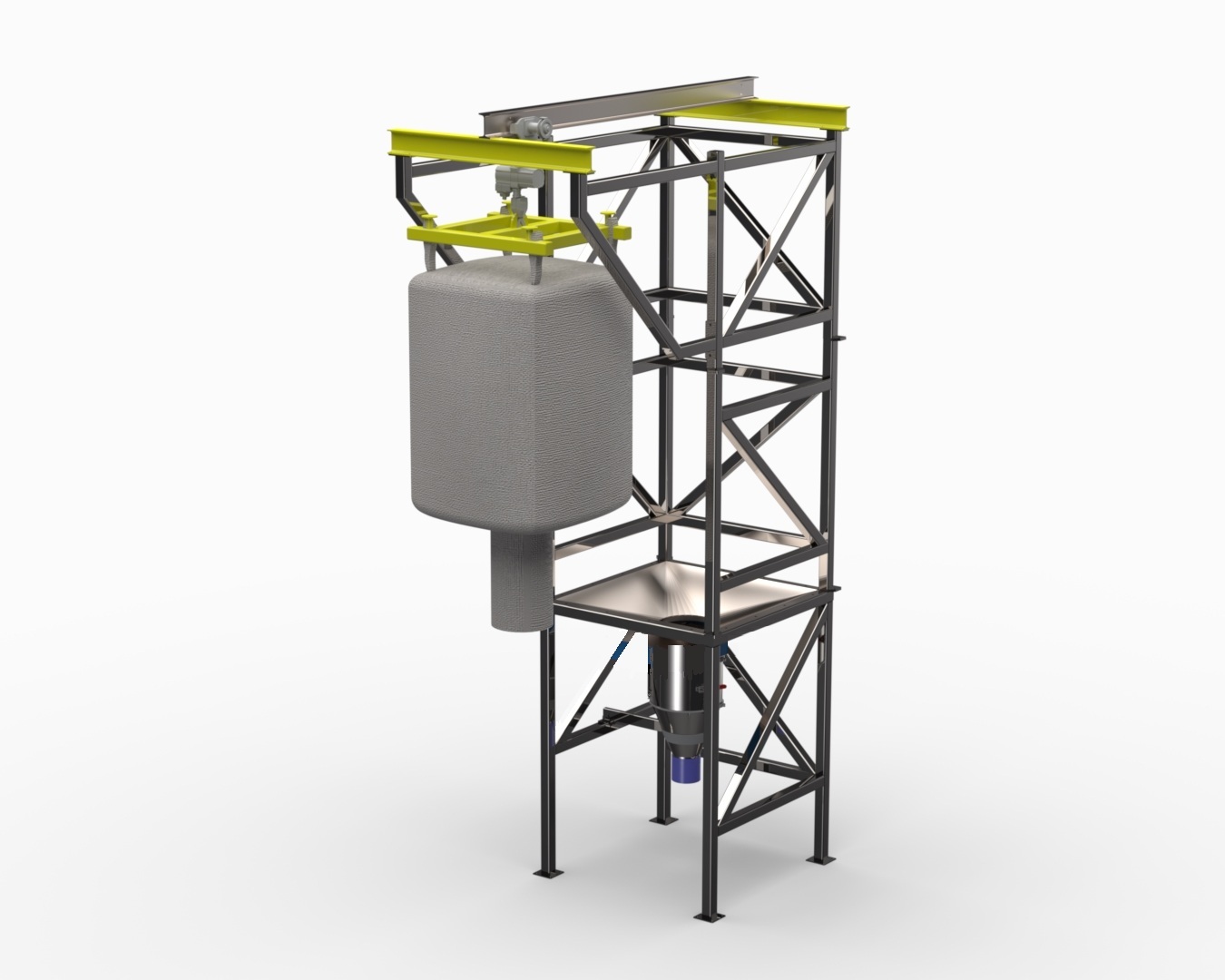
A standard big bag discharge station comprises:
- A support frame for suspending or seating the bag — forklift-loaded, hoist-loaded, or crane-loaded
- A bag spout access enclosure or Untie Chamber for safe, dust-free access to the bag outlet
- Flow aids — massager paddles or vibration units — to promote material movement in difficult-flowing products
- A discharge chute connecting to downstream equipment
- Dust control features: sealed enclosures, BFM flexible connectors, or extraction ports
Optional enhancements include integrated weight cells, in-line screening and magnetic separation, automatic bag piercing or blade-opening (for bags without outlet spouts), and integrated conveying via screw conveyor, vacuum transfer, or aero-mechanical systems.
FIBC Bag Outlet Types — Why They Matter for Discharger Selection
The type of bag outlet directly affects how the discharger must be configured. The most common types encountered in UK industry are:
- Discharge spout (most common) — the bag has a sewn tube outlet that is tied off; an untie chamber or enclosed access point allows safe, dust-free opening.
- Conical spout — the bag base tapers to a cone to encourage complete emptying, reducing product left in corners. Useful for cohesive or expensive materials.
- Plain bottom (no spout) — the bag must be cut open or pierced using a bag-blade unit. Used for single-trip disposable bags. Gough Engineering can supply integrated bag-blade opening technology for these applications.
- Duffle bottom — the entire base opens, releasing material rapidly. Used for coarse or poorly flowing materials such as aggregates.
Confirming the bag outlet type with your material supplier before specifying the discharger avoids costly retrofits.
If your bag types vary, Gough Engineering can design systems to accommodate multiple outlet types within a single installation.
Key Benefits
Switching from manual small-bag handling to a bulk bag discharge system delivers measurable advantages across cost, safety, quality, and compliance:
- Economics — Bulk bags typically weigh 500–1,500 kg, compared to 20–25 kg for small bags. Buying raw material in bulk significantly reduces per-unit material costs and cuts handling time throughout the supply chain — from goods-in through to in-process transfer.
- Labour Savings — Automated discharge eliminates repetitive manual lifting, cutting, and emptying of small bags. This increases throughput, reduces operator fatigue, and substantially lowers manual handling injury risk.
- Dust Control — Sealed discharge enclosures, BFM fittings, and extraction connections minimise airborne dust — protecting worker health, maintaining a clean production environment, and preventing costly product loss.
- Product Integrity — Controlled, enclosed discharge prevents contamination from the environment and between product runs. Critical in food, pharmaceutical, and high-purity chemical applications.
- Modularity — Systems can be integrated with weight cells, conveyors, agitators, in-line screening, magnets, and batching or mixing lines — often within a single footprint.
- Regulatory Compliance — UK discharger installations must satisfy HSE manual handling guidance, the Supply of Machinery (Safety) Regulations 2008, ATEX/DSEAR requirements (where applicable), and sector-specific standards such as BRCGS for food and GMP for pharmaceuticals.
Choosing the Right Discharger Configuration
Big bag dischargers are not one-size-fits-all. The configuration must suit the way bags are moved in your facility, the headroom available, and the number of discharge bays required.
The main options are:
- Forklift-Loaded Dischargers
The most common configuration in UK manufacturing. A cruciform (cross-shaped lifting frame) attached to the bag's lifting loops is engaged by forklift forks and placed directly onto the discharge frame. Forklift-loaded systems are fast, require no overhead infrastructure, and suit facilities where bags are moved on pallets. The discharge frame can be configured for front-, back-, or side-loading to fit any plant layout.
- Hoist-Loaded Dischargers
Where forklifts cannot access the discharge area, an integrated overhead hoist and pendant control raises the bag into position. Electric and pneumatic hoists are available — pneumatic hoists are required in ATEX-classified zones. Hoist-loaded systems are well-suited to tight spaces, elevated platforms, and installations where the bag must be positioned precisely over a downstream vessel or conveyor.
- Low-Headroom and Split-Frame Designs
Where ceiling height is restricted — a common constraint in older UK manufacturing facilities — a split-frame or partial-frame design allows the discharger to be assembled around the bag in situ, rather than requiring the full frame height to be clear before loading. Gough Engineering designs full, semi, and partial frame configurations to suit available headroom without compromising structural integrity or safe working load.
- Multi-Bay Shared Frame Systems
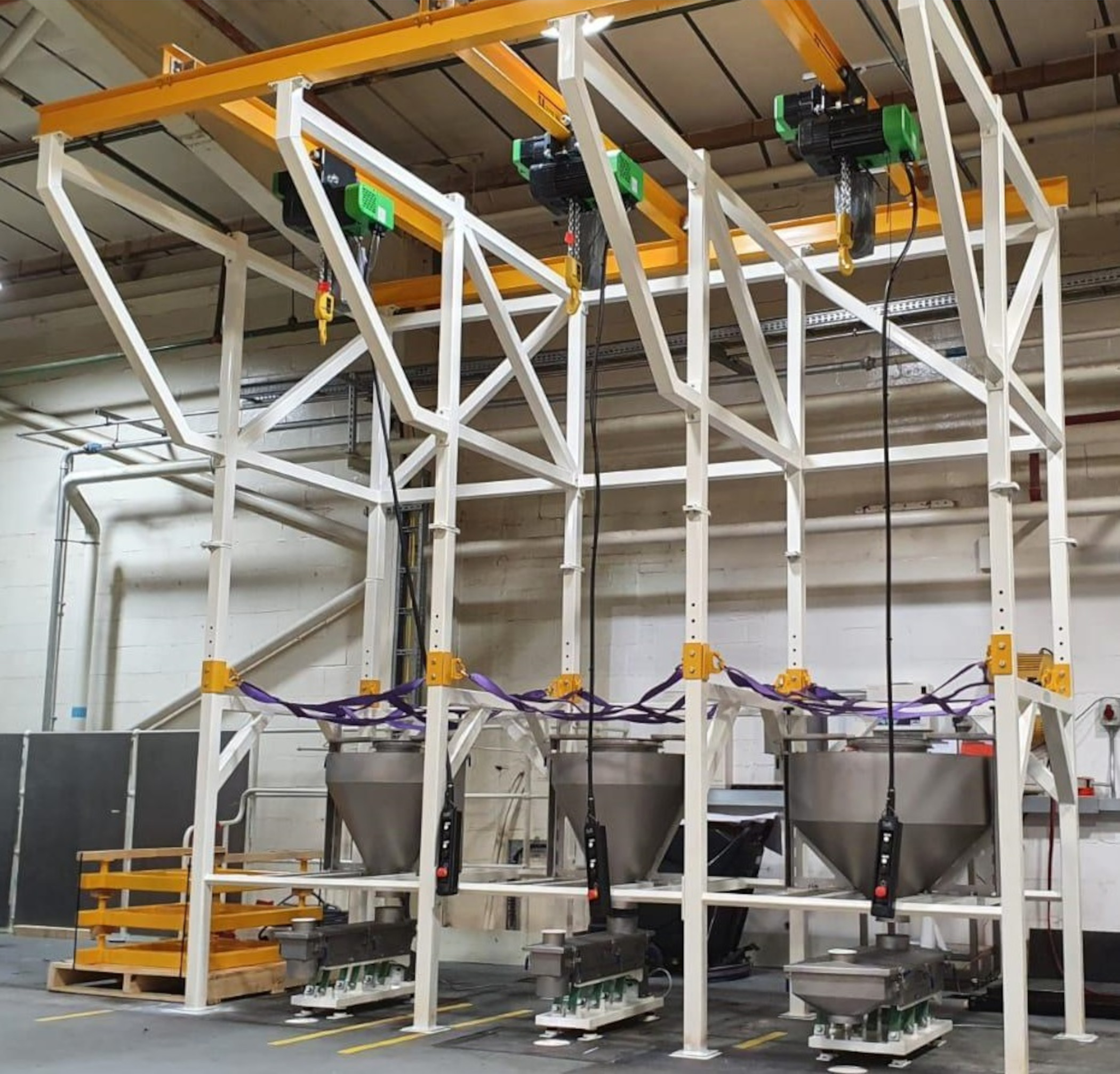
For operations running multiple bags simultaneously — or requiring continuous feed to avoid production stoppages between bag changes — single, double, triple, and multi-bay frames can be built on a shared structural chassis. Gough's triple GBB system supplied to Lavazza's UK facility demonstrates how three independent discharge stations can operate from one robust frame, with each bay retaining its own hoist, hopper, and downstream feed equipment.
- Portable Dischargers
Where the discharge point needs to move between locations or the installation is temporary, portable discharger designs with integrated frames and mobility features can be specified. Discuss your specific requirements with the Gough Engineering team.
Applications Across UK Industries
Big bag discharge systems are deployed wherever large volumes of dry bulk materials need to be transferred safely, consistently, and with minimal operator intervention.
- Food & Beverage
Hygiene and traceability are non-negotiable in food manufacturing. Stainless steel GBB dischargers are widely used to unload flour, sugar, starches, salt, cocoa, coffee, and other dry ingredients. Systems for food applications are typically specified to meet BRCGS and EHEDG standards, incorporating BFM flexible connectors, clean-in-place (CIP) compatibility, and enclosed discharge to prevent contamination. Gough Engineering has supplied discharging systems to leading food brands — including the triple GBB discharging station for Lavazza's Basingstoke facility, handling multiple powders and granules in a three-bay configuration at up to 1,500 kg per bag.
- Chemical Manufacturing
Chemical producers rely on big bag dischargers to handle hazardous or potentially explosive powders — resins, pigments, catalysts, additives, and more. ATEX-certified systems, including ATEX-rated electric or pneumatic hoists and pneumatically controlled paddle massagers, are essential to prevent ignition in classified hazardous areas. The FIBC bag itself must also be the correct type for the dust's electrostatic classification (Type A, B, C, or D) — consult your DSEAR risk assessment before specifying.
- Pharmaceuticals
In pharmaceutical manufacturing, dischargers are fully enclosed with containment solutions designed to meet Occupational Exposure Limit (OEL) requirements. These systems protect operators from potent active pharmaceutical ingredients (APIs) and prevent cross-contamination between product campaigns. Split butterfly valves, glove-box untie chambers, and continuous liner systems are common features in high-containment pharmaceutical discharger installations.
- Construction & Aggregates
Cement, lime, gypsum, fly ash, and similar coarse or adhesive materials demand heavy-duty discharge frames and robust flow aids to ensure blockage-free, consistent material flow. High bag weights and abrasive products require equipment designed and rated for demanding industrial duty cycles. Gough's 80 x 80 box section frame construction is well-suited to these applications.
- Agriculture
Fertilisers, grain treatment compounds, seeds, and agricultural additives are increasingly supplied in one-tonne FIBCs. Big bag dischargers enable fast, dust-controlled unloading into process or mixing equipment, supporting the efficiency and hygiene requirements of modern agri-processing facilities.
- Plastics & Recycling
Big bag unloaders feed granules, regrind, and resins into plastic processing lines, and supply reprocessed materials to shredders or extrusion lines in recycling facilities. Clean, controlled discharge is essential to maintain product quality and prevent contamination in recycled material streams.
Key Considerations When Specifying a Big Bag Discharge System
A complete specification brief ensures the system integrates with your process, meets your compliance obligations, and performs reliably from day one. Address each of the following before approaching a supplier:
- Material properties — bulk density, particle size distribution, moisture content, flowability (free-flowing or cohesive), abrasiveness, and any hazardous classification (dust explosion group, MIE, electrostatic sensitivity).
- Bag specification — bag dimensions when full and empty, outlet spout type (spouted, conical, plain-bottom, duffle), lifting loop design, and whether single-trip or multi-trip bags are used.
- Bag handling method — forklift, pallet truck, or integrated hoist (electric or pneumatic); and loading direction — front-, back-, or side-loading.
- Site constraints — available headroom, floor loading limits, access restrictions for operators and maintenance personnel, and proximity to classified ATEX zones.
- Throughput requirements — target discharge rate (kg/hr or bags per shift), batch or continuous operation, and whether multiple bays are needed to maintain uninterrupted production.
- Downstream interface — connection type, height, and compatibility with receiving equipment such as hoppers, vibratory feeders, screw conveyors, mixers, or screening equipment.
- Quality and contamination control requirements — in-line screening to remove fines or oversized particles; magnetic separation to remove ferrous contamination; dust containment or extraction requirements.
- Environment and compliance — hygiene classification (food-grade, pharmaceutical GMP), ATEX zone designation (if applicable), and sector-specific standards (BRCGS, EHEDG, OEL).
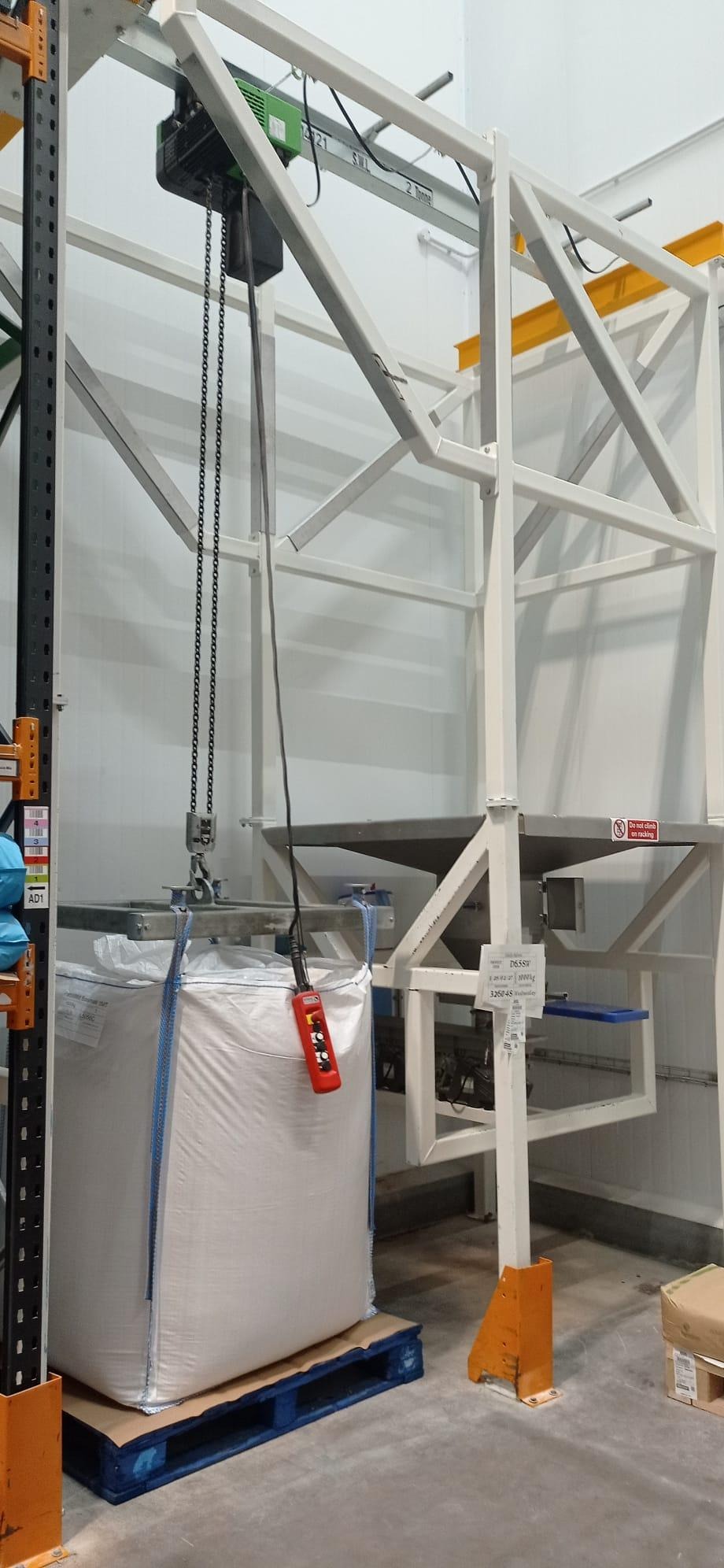
Not sure where to start? Gough Engineering offers an in-house trials facility where you can test material behaviour and confirm the optimum discharger configuration before committing to a full installation. Trial the system with your own materials — contact the team to arrange.
Why Choose the Gough Engineering GBB Big Bag Discharger?
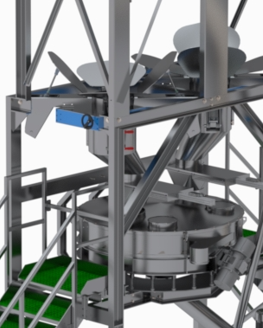
Gough Engineering has designed and supplied bespoke big bag discharge systems for UK manufacturers for many years, across food, chemical, pharmaceutical, construction, agriculture, and plastics sectors.
The GBB range is built on heavy-duty UK engineering, operational flexibility, and in-house support from initial concept through to installation and after-sales.
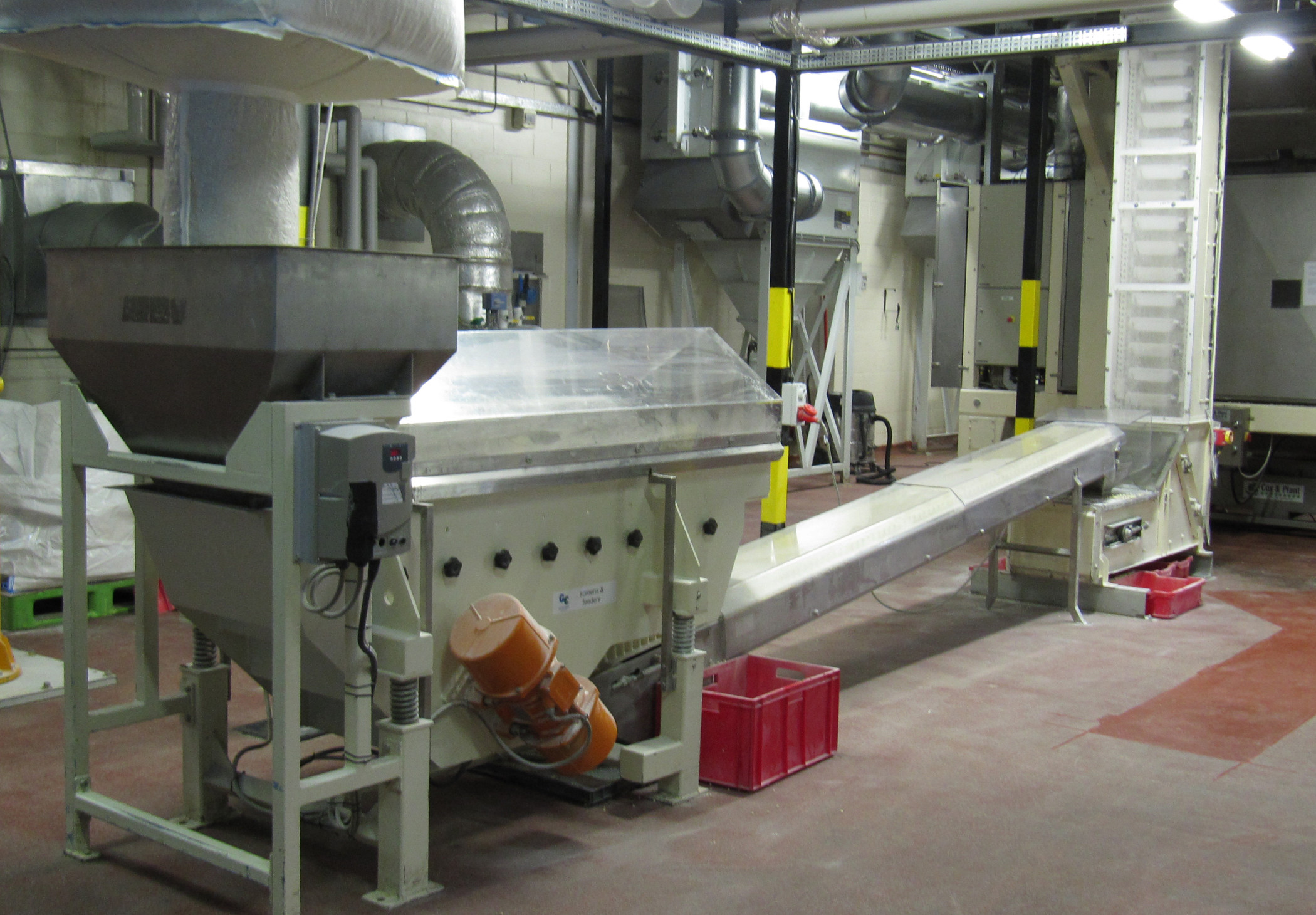
Did you know you can screen unwanted material out of good product while it is discharging…
The Lavazza Partnership — A Case in Point
In 2020, Gough Engineering delivered Lavazza's first triple FIBC big bag discharging station at their Basingstoke, UK facility — a custom-designed system handling multiple powders and granules at up to 1,500 kg per bag.
In 2024, Lavazza returned to Gough for a second, taller system for a new production line, demonstrating their confidence in the engineering and long-term service relationship.
The system features a triple GBB shared frame, individual ATEX-rated electric hoists, cruciform loading, stainless steel chain bag support, circular hoppers with clamp rings, and dedicated vibratory feeders (GLVF) — all designed, manufactured, and installed by Gough from a single point of accountability.
Key features of the GBB range:
- Heavy-duty rigid frame construction using 80 x 80 box section steel, rated for continuous industrial duty.
- Single, double, triple, and multi-bay shared frame configurations — with cost efficiencies through shared structural elements across multiple discharge bays.
- Front-, back-, and side-loading configurations to suit any plant layout, forklift approach, or hoist installation.
- Full, semi, and partial (low-headroom) frame designs — specifically engineered for sites with restricted ceiling height.
- Integrated in-line screening using the Gough Vibraflo (GVF) range — removing contaminants, fines, or oversized material during discharge without an additional process step.
- Integrated magnetic separation to capture ferrous contamination before material enters downstream equipment.
- Elevation conveying integrated directly into the discharge system — screw conveyor, vacuum transfer, or aero-mechanical Floveyor — transferring material to elevated process points without additional handling.
- ATEX-rated hoists (electric or pneumatic) and pneumatic paddle massager controls for use in classified hazardous areas.
- Bag-blade opening technology for plain-bottom bags without outlet spouts.
- Untie chambers with BFM sealed enclosures, agitation systems (paddle or vibration), cruciform bag supports, and bespoke downstream interfaces for every application.
- Full engineering support from concept design and drawings through to manufacture, supply, installation, commissioning, and ongoing after-sales service.
Gough's unique advantage:
Unlike many discharger suppliers, Gough Engineering owns the complete downstream process chain — from the GBB discharger through in-line Vibraflo screening (GVF), to vibratory feeding (GLVF), through to aero-mechanical conveying via Floveyor. This means the entire system is designed, built, and supported by one team — with no finger-pointing between suppliers when questions arise.
In-House Trials Facility
Gough Engineering operates an in-house trials facility — a differentiator no standard discharger supplier offers. Customers can test their actual materials on representative equipment before finalising the specification, confirming flow behaviour, discharge rates, and system configuration with confidence. Equipment hire is also available for short-term production needs or extended trials.
Regulatory Compliance in UK Installations
UK operators specifying big bag discharge equipment must ensure systems comply with applicable legislation. Key requirements include:
- Health and Safety at Work Act 1974 and Manual Handling Operations Regulations 1992 — the primary legal framework governing operator safety. Switching from small bags to FIBC discharge systems is one of the most effective manual handling risk reductions available.
- Supply of Machinery (Safety) Regulations 2008 — the UK framework for machinery placed on the UK market. CE marking remains indefinitely accepted in Great Britain under current UK legislation for machinery in this category.
- Dangerous Substances and Explosive Atmospheres Regulations 2002 (DSEAR) — UK implementation of the ATEX framework. Where combustible or flammable dusts are handled, a DSEAR risk assessment determines the zone classification and required equipment certification. FIBC bags must also be the correct type (A, B, C, or D) for the electrostatic classification of the dust.
- Food Standards Agency regulations for food contact materials, BRCGS Global Standard for Food Safety, and EHEDG hygiene design guidelines — applicable to food and beverage installations.
- Good Manufacturing Practice (GMP) guidelines and OEL containment requirements — applicable in pharmaceutical manufacturing.
Gough Engineering works with customers to ensure every system is designed and specified to meet the regulatory requirements of its industry and operating environment. Where ATEX certification is required, this is confirmed and documented as part of the project scope.
Frequently Asked Questions
What is the difference between a big bag discharger and a bulk bag unloader?
They are the same equipment. 'Big bag discharger', 'bulk bag unloader', 'FIBC discharger', 'bulk bag discharge station', and 'super sack unloader' all refer to systems that empty one-tonne flexible bulk containers in a controlled, safe manner. The terminology varies by sector and supplier — the function is identical.
What materials can a big bag discharger handle?
Big bag dischargers are suitable for a wide range of dry bulk materials: powders, granules, flakes, pellets, seeds, and fibrous products. Material characteristics — bulk density, particle size, moisture content, and flowability — determine the flow aid specification, discharge rate controls, and containment requirements. Gough Engineering's trials facility allows you to confirm behaviour with your specific material before finalising the design.
Do I need an ATEX-rated system?
ATEX certification is required where the operating environment is classified as a potentially explosive atmosphere — typically where combustible dust is present above its minimum explosible concentration. Your DSEAR risk assessment defines the zone classification. The FIBC bag type must also be matched to the dust's electrostatic sensitivity. Gough Engineering can supply fully ATEX-compliant systems including rated hoists and pneumatic controls, and can advise on compliance requirements during the design stage.
My bags do not have an outlet spout — can you still discharge them?
Yes. Gough Engineering can supply integrated bag-blade opening technology for plain-bottom bags that must be pierced or cut to discharge. This maintains dust containment and operator safety without requiring a spout-type bag.
What headroom do I need?
As a general guide, a standard hoist-loaded system requires approximately 4,500–5,500 mm of clear headroom — the Lavazza system at Basingstoke stands at 5,500 mm. Where headroom is restricted, Gough Engineering designs full, semi, and partial (low-headroom) frame configurations specifically to work within your site's constraints.
Can one frame serve multiple discharge bays?
Yes. The GBB range supports single, double, triple, and larger multi-bay shared frame configurations. Shared frames reduce the per-bay capital cost while maintaining individual discharge control at each station. Gough's triple GBB system for Lavazza is a live example of this approach.
Can the discharger be integrated with my downstream equipment?
Yes, and this is a core Gough Engineering capability. The GBB discharger can be designed to connect directly to vibratory feeders, screw conveyors, vacuum transfer, aero-mechanical Floveyor conveyors, in-line screeners, and mixers — all as part of a single engineered system. Gough owns and manufactures the downstream equipment as well as the discharger, which means one supplier, one design authority, and one point of contact for the entire system.
Do you offer hire or trials before committing to purchase?
Yes. Gough Engineering operates an in-house trials facility where customers can test their own materials on representative equipment before finalising the specification. Equipment hire is also available for production trials or short-term requirements. This is a service very few suppliers in this market can offer.
Conclusion
Big bag dischargers are an essential component of modern UK industrial operations — enabling safe, efficient, and compliant handling of bulk materials at scale. Whether you are managing food ingredients, chemical powders, pharmaceutical actives (APIs), construction aggregates, agricultural inputs, or recycled plastics, the right discharge system reduces manual handling risk, controls dust, protects product quality, and integrates cleanly with your process.
Gough Engineering also supplies bespoke big bag filling stations — completing the bulk handling loop for operations that both receive raw materials in FIBCs and dispatch finished product in them. If filling is part of your process, speak to the team about a combined discharge and filling solution.
Gough Engineering — Gough & Co. (Engineering) Ltd — is a UK-based manufacturer and systems integrator with a proven track record across industries. The GBB big bag discharger is one element of a fully integrated bulk handling capability: from discharge, through screening and separation, to conveying and feeding. Every system is engineered and built in the UK, with full design, supply, installation, commissioning, and after-sales support from a single team.

You can find more information about our standard range of products and bespoke engineering solutions on www.goughengineering.com. Or, why not telephone +44 (0) 1782 567770 and chat with one of our sales team.
On our website, GOBi (Gough Objective Bot Intelligence) provides answers to a variety of questions and you can always contact him with your specific enquiries using our form, click on the Contact button on any webpage.
Illustrations
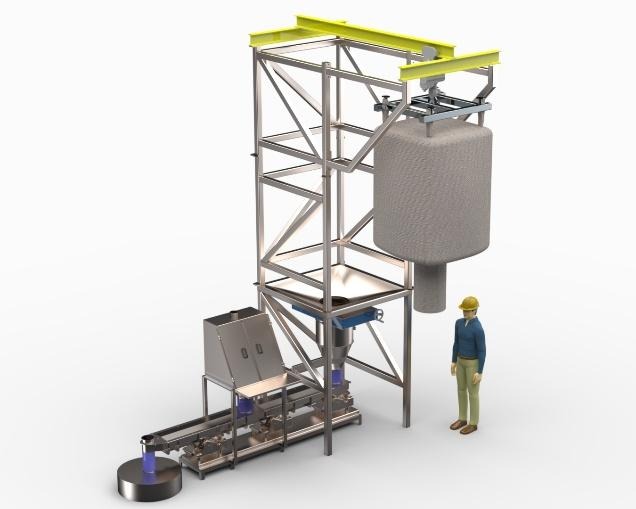
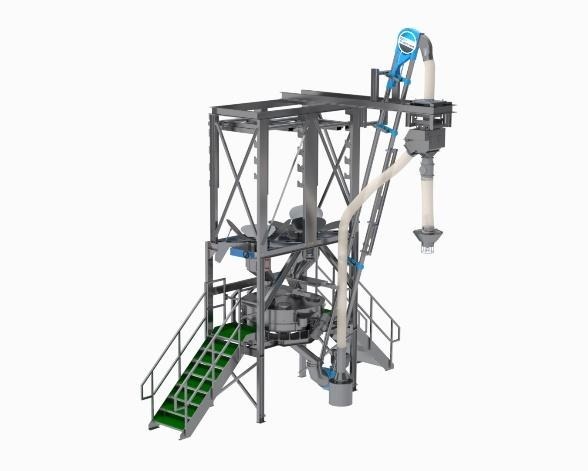
Scheme showing Big Bag Discharger with Gough Big Bag Discharger (Forklift hoist and small bag Rip & Tip Station with Forklift loaded bags, contaminates into a long vibro Feeder GLVF vibrating Vibraflo Screener (GVF) into Aero-Mechanical Floveyor with final Metal Detection
Gough has supported many companies with big bag discharge systems, all tailored for their operation and production requirements.








Interesting Links
https://www.goughengineering.com/en/product-handling-equipment/fibc-big-bag-dischargers
https://www.goughengineering.com/en/product-handling-equipment/vibratory-feeders
https://www.goughengineering.com/en/contact-us
Article